





Today, every business wants to use AI agents for support, sales, service, and operations. But without a clear understanding and roadmap for agentic maturity, organisations risk confusion, low value, or failed projects. Moving through maturity stages with structure, strong data practices, and orchestration readiness is the key to agentic success.
This blog explains each maturity level, why it matters, how it ties to your data foundations, and how you can move from basic automation to becoming a fully agentic enterprise.
What is agentic maturity?
Agentic maturity describes how ready your organisation is to use AI agents in daily work. It shows the steps from simple automation to full, multi-agent systems that can think, act, and work across your whole business. It's a clear roadmap that explains what you can do today and what you need before you can scale advanced agentic systems.
Agentic maturity matters because too often companies deploy AI tools fast, but struggle to make them useful across teams.
And yes, agents can be deployed quickly, but scaling them effectively across the business requires a thoughtful, phased approach.
You cannot skip the foundations for great AI. Building maturity step by step to reach safe and powerful automation is the key to success.
That's because agentic maturity links directly to how well your data, systems, and workflows work together. When your data is not ready, your agents cannot make good decisions. When your workflows are not connected, your agents cannot help across domains. When your governance is weak, your agents cannot operate safely.
So the maturity model helps you understand gaps early.
Why is agentic maturity important?
Agentic maturity matters because it shapes how well your organisation can use AI agents to create real business ROI. Without a clear maturity path, teams often deploy agents that cannot scale, cannot integrate with data, or cannot make safe decisions. Understanding your maturity level helps you apply agentic systems in a controlled, effective way.
As companies adopt more agents, the role of agentic analytics grows. Instead of only showing dashboards, analytics becomes active. AI agents begin to read data, reason about it, and take actions. This shift only works when your organisation builds the right maturity around data, automation, and governance.
Salesforce states that agentic AI is a major step beyond traditional copilots. Copilots assist. Agents act. This action requires orchestration, trust, and well-prepared data.
Moving too fast without proper maturity leads to failure. Many companies today try to deploy agents across complex environments but lack stable integrations, consistent data, or workflow clarity. That’s a big problem for successful AI implementations and a major reason why Gartner predicts that over 40% of agentic AI projects will be shut down by 2027 due to poor planning and low readiness.
Thinking about agentic maturity protects you from risk. It’s how mature organisations move from AI prototypes to actual production by following a clear roadmap.
As a final point, there’s no great AI without great data. So agentic maturity is naturally tightly linked to data maturity. When data is clean, connected, and harmonised, agents can reason and act well. When data is siloed or low quality, agents cannot make safe decisions. Better data maturity leads to better insights, more accurate agent behaviour, and stronger orchestration across the business.
Agentic maturity matters. It helps you build safer systems, reduce project failure, and unlock higher-value agentic use cases across your teams and tools.
Agentic maturity levels
Agentic maturity is built on clear levels that show how far your organisation has come in using AI agents. Each level shows how much reasoning, action, and orchestration your agents can handle. These maturity levels come from Salesforce’s Agentic Maturity Model and help you understand what is possible at each stage.
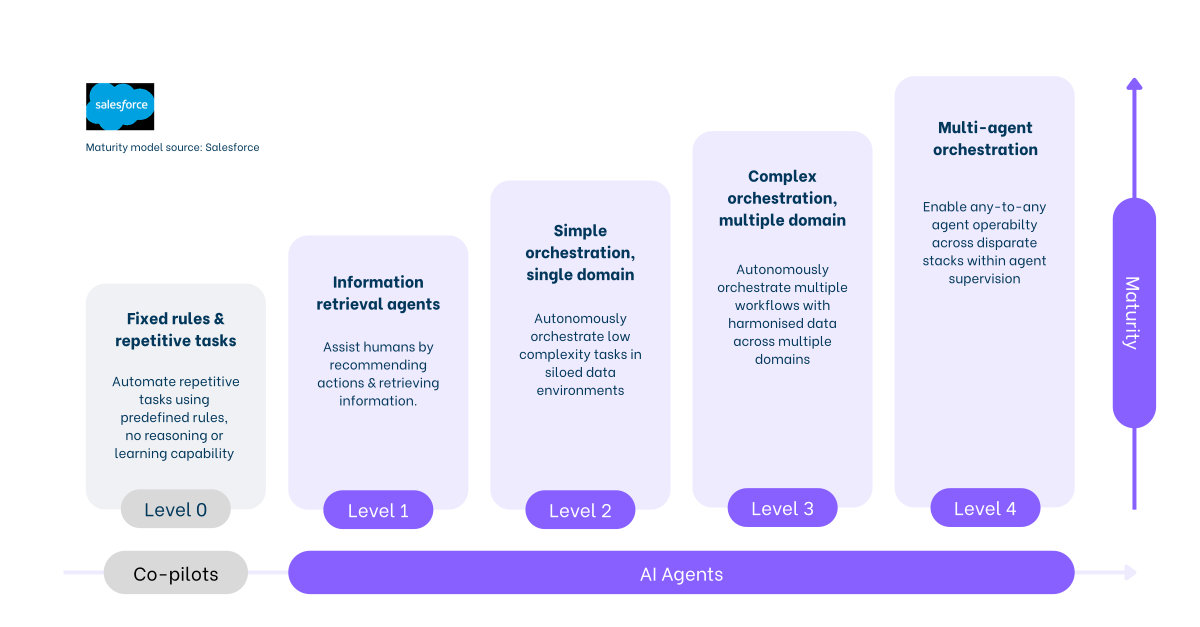
Level 0 — Fixed rules & repetitive tasks
Level 0 is where most companies begin.
At this level, you rely on rule-based automation and simple scripts. These systems follow fixed instructions and cannot learn or make decisions.
Key traits:
- Agents cannot reason or take actions beyond pre-set rules.
- Automation covers simple, repetitive tasks like data entry, ticket routing, or robotic process automation.
- Basic chatbots may exist, but they give static or menu-based responses.
- No autonomy, no orchestration, and no domain intelligence.
This level shows the starting point before real AI agents or agentic analytics appear.
Level 1 — Information Retrieval Agents (agentic analytics)
Level 1 introduces real AI agents, but they still depend on humans to take action.
Key traits:
- Agents retrieve information, summarise content, and suggest actions.
- They support humans, but do not execute tasks on their own.
- Common in copilots that help with emails, case summaries, and recommendations.
- Early agentic analytics appears, but insight still requires human action.
This level is where many organisations are today that are adopting AI agents.
Level 2 — Simple Orchestration, Single Domain
Level 2 is the first true step into agentic behaviour.
Key traits:
- AI agents can now act, not just advise.
- They complete tasks inside one business domain such as sales, support, or finance.
- Workflows become end-to-end but stay isolated inside one system.
- Data remains siloed, limiting complexity.
Example: An agent that updates CRM records, opens service cases, or processes orders inside one system.
This level begins the shift from “assistive AI” to “autonomous AI.”
Level 3 — Complex Orchestration Across Multiple Domains
Level 3 unlocks real value because agents now act across your organisation.
Key traits:
- AI agents integrate across multiple business domains.
- They can coordinate tasks between systems such as CRM, billing, logistics, and knowledge bases.
- This stage requires harmonised data, because agents need reliable information across platforms.
- Agentic analytics becomes powerful — agents read, interpret, and act on data across the business.
Example: An agent that resolves customer issues by checking orders, updating billing details, and contacting logistics automatically.
Level 4 — Multi-Agent Orchestration (Full agentic maturity)
This is the highest level of agentic maturity.
Key traits:
- Multiple agents work together and delegate tasks to each other.
- Agents operate across all enterprise systems and can perform any-to-any interactions.
- Requires strong data maturity, governance, compliance, and safe human supervision.
- Agents act as digital teammates, handling complex, multi-step work across the entire business.
This level turns your organisation into a fully agentic enterprise.
Research on enterprise readiness and digital labor orchestration emphasises this level as the future of work.
How to move up through the agentic maturity model?
Sure the model makes sense, but the big question remains: how do you move up through the agentic maturity stages?
Well, most companies cannot reach advanced agent orchestration from day 1, simply because they lack experience with AI agents, workflow redesign, data harmonisation, and governance. It’s crucial to take things one step at a time to fill these gaps with strategy, technical skills, and proven frameworks.
Step 1: Shape your AI strategy
No rocket ship ever launched without a solid game plan. So first, you need to build a clear plan for where and how AI agents can create value. This includes:
- Assessing your organisation’s current maturity level.
- Identifying high-value workflows suitable for automation.
- Designing a safe, phased rollout that matches business readiness.
- Ensuring AI strategy aligns with data, compliance, and governance constraints.
Agentic transformation requires combining industry knowledge with deep AI expertise so companies avoid rushing into deployments without proper foundations.
Step 2: Start small and find value
Once you identified areas for AI activation with a solid phased rollout plan, make sure to begin with narrow, high-impact use cases. Starting small reduces risk and shows early returns, which builds confidence inside the organisation.
This stage focuses on:
- Quick prototypes to test agent behaviour.
- Short, measurable experiments.
- Early wins that prove value before scaling.
This approach prevents the failure patterns described by Gartner, where many agentic AI projects fail due to poor planning or unrealistic scope.
Step 3: Expand use cases
After early wins, you can support the shift from single-domain agents to cross-business agents. This step usually includes:
- Adding system integrations so agents can work across departments.
- Introducing more complex workflows and automation logic.
- Scaling AI adoption so agents support more teams.
- Improving data flows to support better reasoning and orchestration.
Build the scalable architecture and connections needed for agents to operate safely across multiple domains.
Step 4: Optimize for the future
To reach higher maturity levels, you must continually improve data maturity, governance, and agent performance. This involves:
- Strengthening governance and guardrails.
- Ensuring data is harmonised, accurate, and ready for advanced agent tasks.
- Monitoring agent behaviour and adjusting rules or training.
- Designing long-term operating models for agentic enterprises.
Data maturity as the foundation for analytics maturity
Agentic maturity and data maturity are tightly linked. AI agents can only act, reason, and orchestrate work when the data they rely on is complete, connected, and trustworthy. If the underlying data is weak, fragmented, or inconsistent, agent behaviour becomes unreliable. This is why organisations must raise their data maturity as they progress through the agentic maturity model.
Strong data maturity provides the foundations agents need to work safely and effectively:
Harmonised data: AI agents need a unified view of customers, products, and operations. If information sits in different systems with different formats, agents cannot make good decisions. Higher data maturity removes silos so agents can work across domains.
Accurate and clean data: Agents use data to reason. Poor data leads to incorrect actions, faulty predictions, and workflow errors.
Governed data: Governance ensures that data is used responsibly, with the right privacy, compliance, and access controls. Mature governance protects both the company and the end user.
Real-time data: Advanced agents require up-to-date information to act autonomously. Data pipelines and integrations must support real-time or near-real-time access.
This connection is also visible in agentic analytics, where analytics becomes active rather than passive. As data maturity improves, analytics shifts from producing static dashboards to enabling AI agents to interpret information and take action. At higher maturity levels, agentic analytics becomes a core part of autonomous decision-making.
Conclusion: the journey to agentic maturity
Agentic maturity gives you a clear, structured roadmap for adopting and scaling AI agents across your business. It shows how to move from simple rule-based automation to fully orchestrated, multi-agent systems that can work across every domain. By understanding your maturity level, you can make better decisions, reduce risk, and unlock more value from agentic technology.